
Airdrops Explained: Why Crypto Projects Give Tokens Away
Learn what crypto airdrops are, why projects give tokens away, how snapshots and eligibility work, plus airdrop types, taxes, and scam warning signs.
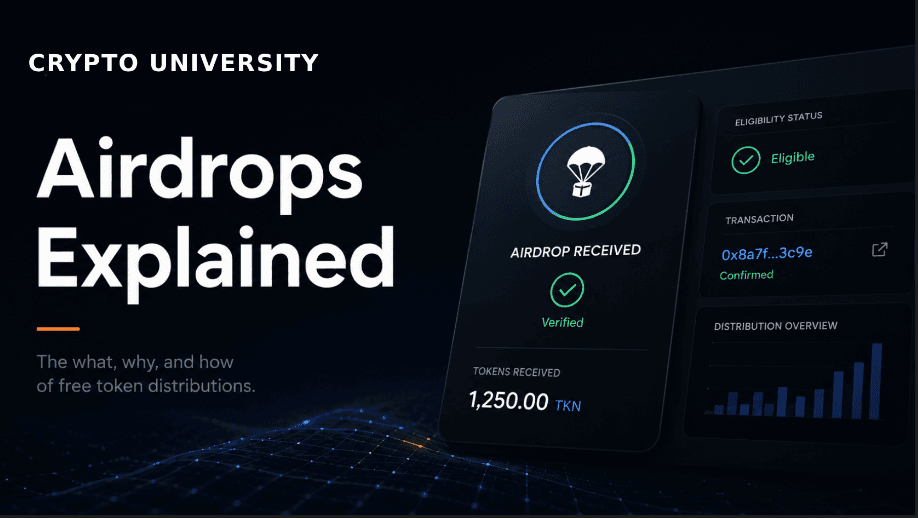
Key Takeaways
An airdrop is a token distribution method, not a giveaway. Projects use it to spread ownership, decentralize governance, and attract users, and the tokens are usually paid for with something: your activity, your capital, your attention, or your data.
Eligibility is decided by a snapshot. A project records blockchain activity at a specific moment, filters out fake accounts, then distributes tokens either automatically or through a claim page.
Airdrops carry real costs and real risks. Transaction fees, capital lock-up, tax obligations on receipt, and a large ecosystem of fake claim sites and wallet drainers mean free tokens are rarely free.
What Is a Crypto Airdrop?
A crypto airdrop is a distribution of tokens to a list of blockchain wallet addresses, usually at no direct cost to the recipient. The project decides which addresses qualify, takes a snapshot of blockchain data at a chosen point in time, and then either sends the tokens straight to those wallets or opens a claim page where eligible users collect them.
It helps to drop the word free for a moment. An airdrop answers a question every new token project must solve: who should end up holding this token? Selling the entire supply to investors concentrates ownership in a small group. Handing a portion to people who actually use the product spreads it out. The airdrop is the mechanism for that second option.
Why Projects Give Tokens Away
There is no single motive. Most airdrops pursue several goals at once, and the design of the drop reveals which one the team cared about most.
1. To Decentralize Ownership and Governance
Many tokens are governance tokens, meaning holders vote on protocol changes, treasury spending, and fees. A protocol whose tokens sit only with founders and venture investors is decentralized in name only. Spreading tokens across thousands of independent wallets is how a project can credibly claim that control is distributed.
2. To Solve the Cold Start Problem
Exchanges, lending markets, and bridges are useless when empty. Nobody trades where there is no liquidity, and nobody supplies liquidity where there is no trading. Token rewards pay people to show up first and absorb that unrewarding early period.
3. As a Marketing and Customer Acquisition Budget
A traditional startup spends cash on ads. A token project can spend tokens instead. This preserves cash, but it is not obviously cheaper. Analysis of the Uniswap distribution by investor Tomasz Tunguz estimated that airdrops can cost several times more per acquired user than conventional sales and marketing spending. That is an estimate from one case rather than a rule, but it corrects the idea that airdrops are cheap growth.
4. To Reward Early Users Retroactively
A retroactive airdrop rewards people for what they already did, with no promise made in advance. It is the design most users consider fair, and it signals to the wider market that early adopters get paid back.
5. To Create an Instant Holder Base
Distributing to tens of thousands of wallets creates instant holders, trading activity, and visibility. It also creates instant sellers, a tension built into the model.
Project Goal | How the Airdrop Serves It | What Can Go Wrong |
|---|---|---|
Decentralize governance | Voting power spreads across many independent wallets | Recipients sell immediately, and power re-concentrates with buyers |
Bootstrap liquidity | Rewards pay early users to tolerate an empty product | Liquidity leaves the moment rewards stop |
Acquire users cheaply | Tokens replace a cash marketing budget | Cost per retained user can exceed conventional marketing |
Reward loyal users | Retroactive drops recognise real past activity | Rewards attract farmers who fake loyalty in future |
Build a market for the token | Thousands of holders create instant trading activity | Concentrated sell pressure at launch |
How an Airdrop Works, Step by Step
Criteria are defined. The team decides what counts: past transactions, volume traded, liquidity provided, assets bridged, NFTs held, or points earned. Criteria are often kept secret so they cannot be gamed.
A snapshot is taken. The project records the state of the blockchain at a specific block or timestamp. Activity after that moment usually does not count, and snapshot dates are often announced only once they have passed.
Sybil filtering is applied. The team removes addresses it believes belong to one person operating many wallets. This step now regularly eliminates a large share of applicants.
Allocations are calculated. Some drops give every eligible wallet the same amount. Most now weight allocations by activity, volume, or points.
Tokens are distributed. They either appear directly in wallets or must be collected from a claim page for a network fee. Claim windows can expire, and unclaimed tokens may return to the treasury.
Vesting or follow-up seasons apply. Many projects release tokens in tranches to encourage continued use rather than an immediate exit.
The Main Types of Airdrops
Type | How You Qualify | Typical Example |
|---|---|---|
Retroactive usage drop | You used the protocol before a secret snapshot | Uniswap rewarding past traders and liquidity providers |
Points-based drop | You accumulate points over seasons by trading, depositing, or referring | Hyperliquid and the many perpetual exchanges that copied its model |
Holder drop | You hold a specific token or NFT at snapshot time | Ecosystem tokens dropped to holders of a parent chain token |
Task or bounty drop | You complete social tasks, testnet actions, or quests | Early-stage projects seeking visibility |
Fork drop | You hold a coin when its blockchain splits in two | Bitcoin Cash distributed to Bitcoin holders in 2017 |
Unsolicited or dust tokens | You did nothing. Tokens simply appear | Frequently a scam vector, not a real reward |
Three Case Studies Worth Knowing
Uniswap, 2020: The Drop That Set the Template
On 17 September 2020, the decentralized exchange Uniswap distributed its UNI governance token to more than 250,000 addresses that had used its contracts before a 1 September snapshot. Every qualifying address could claim at least 400 UNI, including roughly 12,000 addresses whose only interactions had been failed transactions.
The follow-up data matters more. Analysis published by Dune found that roughly 90 percent of eligible wallets claimed within the first month, tens of thousands never claimed at all, and only a small minority still held the token years later. The drop was highly effective as publicity and far less effective as retention.
Hyperliquid, 2024: The Points Model at Full Scale
On 29 November 2024, the perpetual futures exchange Hyperliquid distributed roughly 310 million HYPE tokens, about 31 percent of total supply, to approximately 94,000 wallets. Eligibility came from a points program that had run for about a year, rewarding trading volume, activity, and referrals. The project reported no venture capital allocation, so the largest slice of supply went to users.
The design mattered more than the size. By tying rewards to fees paid and volume traded, Hyperliquid made farming expensive rather than cheap. Many competitors copied the play-for-points structure in the year that followed.
LayerZero, 2024: Airdrops Meet Enforcement
Ahead of its ZRO distribution, cross-chain protocol LayerZero ran an unusually public anti-fraud campaign. It first identified around two million suspicious addresses, then narrowed the list to 803,093 flagged as likely sybil accounts. Farmers who self-reported were offered 15 percent of their intended allocation, and community bounty hunters were paid a share of the allocations they exposed. Reported cross-chain activity fell sharply once the snapshot was announced, showing how much pre-drop usage was reward-driven.
Airdrop | Mechanism | The Lesson |
|---|---|---|
Uniswap (2020) | Flat allocation to past users | Simple and fair, but easy to farm in future and weak on retention |
Hyperliquid (2024) | Points earned through paid trading activity | Making participation costly filters out low-effort farmers |
LayerZero (2024) | Aggressive sybil filtering and bounties | Projects now actively police who deserves the tokens |
The Sybil Problem: Why Airdrops Got Harder
A sybil attack is when one person controls many wallets to appear as many users. In airdrop terms this is called farming: splitting capital across dozens or hundreds of addresses, doing the minimum qualifying activity in each, and collecting many allocations instead of one.
Farming created a feedback loop that changed the practice. Projects saw impressive user numbers collapse after distribution, so they made qualification harder and more expensive.
Criteria moved from simple activity to weighted metrics such as fees paid, volume traded, and capital held over time.
Points programs stretched qualification across months or seasons rather than a single transaction.
Analytics firms and clustering tools are now routinely used to detect linked wallets.
Some projects now use identity checks or proof-of-personhood systems to limit one allocation per human.
The practical consequence is that casual participation earns less than it did in 2020 and 2021, while the effort needed to qualify has risen sharply.
What Happens After the Tokens Land
The pattern is consistent enough to understand before participating. Many recipients sell quickly, especially those farming rather than using the product, and activity often falls once rewards stop. Deposits and trading volume can decline steeply in the weeks after a distribution.
This is why vesting, multi-season programs, and staking requirements have become standard. They try to convert a one-off payment into an ongoing relationship, with results that vary widely.
The Real Costs and Risks for Users
Cost or Risk | What It Means in Practice |
|---|---|
Transaction fees | Qualifying activity and claiming both cost network fees, which are lost whether or not a drop ever arrives |
Capital at risk | Funds deposited into a protocol to farm are exposed to smart contract bugs and market moves |
Opportunity cost | Time and money committed to a protocol that may never issue a token |
Tax on receipt | In many jurisdictions tax is owed on the value at receipt, even if the token later falls |
No guarantee | Many drops are worth very little, and some anticipated tokens never launch at all |
Scam exposure | Airdrop interest is one of the most heavily exploited attack surfaces in crypto |
Airdrop Scams and How to Recognise Them
Because airdrop hunting means connecting wallets to unfamiliar websites, it attracts attackers. The most common attack is the fake claim page: a convincing copy of a real project site, often promoted through paid search results or hijacked social accounts, which asks you to connect a wallet and sign a transaction that drains it.
Warning Sign | Why It Matters |
|---|---|
Any request for your seed phrase | No legitimate airdrop needs it. This is always theft |
A request to send tokens to unlock the airdrop | Real drops never require an upfront payment to a wallet address |
Unknown tokens appearing in your wallet | Often bait. Interacting with them can trigger a malicious approval |
Urgency and countdown timers | Pressure is a tactic to stop you verifying the URL |
Direct messages offering help to claim | Support teams do not message first. Assume impersonation |
A signature request you cannot read | Blind signing is how most wallet drains are authorised |
Basic Defensive Habits
Reach claim pages only through links published in a project's official documentation, never through search ads or social media replies.
Use a separate wallet for claiming, holding nothing of value.
Read what you are signing. Reject approvals you do not understand.
Review and revoke old token approvals periodically.
Ignore unexpected tokens rather than interacting with them.
Airdrops and Tax: An Informational Overview
Tax treatment varies significantly by country, and this section is general information rather than advice.
In the United States, the Internal Revenue Service treats cryptocurrency as property under Notice 2014-21. Revenue Ruling 2019-24 addressed airdrops following a hard fork, holding that recipients recognise ordinary income equal to the fair market value of the tokens once they gain dominion and control, meaning when they can transfer, sell, or dispose of them. No single ruling covers every kind of airdrop, but tax professionals broadly apply the same reasoning: income at receipt, then a separate capital gain or loss on sale.
Two consequences follow. Tax can be owed on tokens you never sold, and if the value collapses afterwards the income figure does not shrink retroactively, though the later loss may offset gains. Rules differ by country and change over time, so keep dated records and consult a qualified professional where you live.
How to Evaluate an Airdrop Rationally
A useful filter is to ignore the token and ask about the product.
Would you use this protocol if there were no token? If not, you are farming, not using.
Is the team credible, audited, and transparent about who controls the contracts?
What are you actually risking: gas fees only, or deposited capital?
Has the project promised a token, or is the expectation purely speculation on social media?
Can you afford the tax and effort if the token arrives and then falls sharply?
The Bottom Line
Airdrops are a distribution tool, not a reward for existing. Projects use them because they need holders, users, and a plausible claim to decentralization, and they have grown more selective as farming has grown industrial. The incentives on both sides, a project buying durable users and a farmer extracting tokens cheaply, explain most of how modern airdrops are designed.
For a learner, the most valuable thing an airdrop offers is not the token. It is a reason to actually use a protocol and understand how it works. That knowledge does not expire when the claim window closes.
Frequently Asked Questions
Are airdrops free money?
Not really. Even when tokens cost nothing to claim, you typically pay network fees, commit time, and often commit capital to qualify. Many airdropped tokens end up worth very little, and tax may be owed on the value at the moment you receive them.
Do I have to pay to receive an airdrop?
You may need to pay a network transaction fee to claim tokens. You should never need to send tokens to another wallet or pay a person to unlock an airdrop. Any request of that kind is a scam.
What is a snapshot?
A snapshot is a record of blockchain data at a specific block or moment in time. It fixes who qualifies. Activity after the snapshot usually does not count, which is why snapshot dates are often revealed only afterwards.
What is a sybil attack in the context of airdrops?
It is when one person operates many wallets to appear as many separate users and collect multiple allocations. Projects now spend significant effort detecting and excluding these wallets, and some publish lists of the addresses they have flagged.
Why do airdropped tokens often fall in price after launch?
Because a large number of recipients receive tokens they did not pay for and sell them quickly, while genuine demand is still forming. Vesting schedules and multi-season distributions are attempts to soften this effect.
Unknown tokens appeared in my wallet. What should I do?
Treat them with suspicion and do not interact with them. Unsolicited tokens are commonly used as bait to lure people onto malicious websites or into approving harmful transactions. Leaving them untouched is safe.
Can I still qualify for airdrops with a single wallet?
Yes. Most projects design distributions to reward genuine users, and many now weight rewards by real activity such as volume or fees rather than the number of wallets. Whether that activity is worth the cost and risk to you is a separate question and depends on your own circumstances.
Are airdrops taxable?
In many jurisdictions, yes. United States guidance points to ordinary income at fair market value when you gain control of the tokens, with a separate capital gain or loss when you later sell. Rules differ by country and change over time, so check current guidance for where you live and consult a qualified professional.
Disclaimer: This content is for educational and informational purposes only and is not financial advice. Nothing here is a recommendation to buy or sell any asset or use any platform. Do your own research and manage your risk.
AI Meets DAOs: How Artificial Intelligence Is Changing On-Chain Governance in 2026
Real-World Asset Tokenization Hits $31 Billion: What It Means for On-Chain Finance
How to Safely Use Crypto Bridges in 2026: Risk Assessment Checklist and Best Practices
Need deeper training?
Join our structured modules with live examples and expert checklists for effective implementation.
JOIN THE ACADEMY
Ad
Get a $100K funded account
See current qualification terms and payout conditions.
Sponsored
Share Transmission
Broadcast this signal to your network